Reading the Room: Your Baby's Social Cues in the First Three Months

Photo: Pieter Brueghel the Elder, Public domain, via Wikimedia Commons
It's 4am and you're doing the slow shuffle around the bedroom with a baby who has decided that tonight is a social occasion. You look down. They are looking back. Not at the lamp, not at the shadow on the wall, but at your face — slightly cross-eyed, entirely serious, absolutely fixed on you. It's one of the strangest and loveliest feelings in the world, and it's happening weeks before anyone hands you a milestone chart.
Early social development gets talked about as a checklist: eye contact, tracking, smiling, cooing. In real life it's more like a conversation that starts very quietly and gets louder. Here's what's going on in those first three months, and how to enjoy it without turning your baby into a scorecard.
The first fortnight: a face is the best toy you own
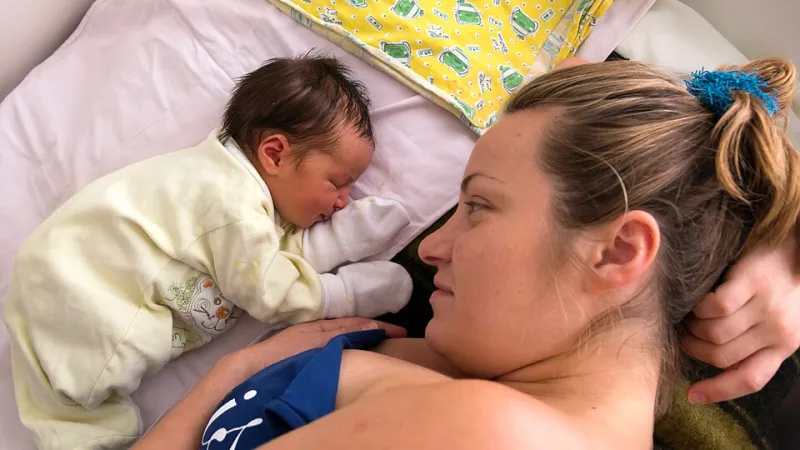
Newborns don't see the world the way we do. Their vision is sharpest at roughly 20 to 30 centimetres — conveniently, about the distance from your face to theirs during a feed. Beyond that, things are soft and vague. What they can pick out is contrast: dark hair against a pale ceiling, the shadow of an eye socket, a bold black-and-white pattern.
So the most developmentally useful object in your house is your own head. Holding them close, letting them study you, pulling a slow and slightly ridiculous face — that's not just bonding, it's the visual workout they're wired for.
Two things worth knowing here. First, newborn smiles during sleep are reflexes, not conversation; enjoy them anyway. Second, babies look away. A lot. That brief breaking of gaze is early self-regulation — a tiny version of taking a breath before carrying on. If your baby stares at you for ten seconds and then turns their head to the wall, they're not bored of you. They're processing.
Around six weeks, the lights come on
Social smiling usually arrives somewhere between six and eight weeks, but four to twelve weeks is well within the normal range. The difference between a reflex smile and a social one is easy to spot once you've seen it: the social smile is a response. It's aimed at you, it appears when you speak or smile first, and it tends to come with crinkly eyes and a general brightening of the whole face.
From there it snowballs. Your face gets a smile, then your voice does, then a silly noise does. Some parents notice their baby smiling at familiar faces before strangers; others find the opposite. Both are ordinary.
Cooing is a conversation, and the pause is the point
Around the same time, the sounds start: soft vowel-ish coos, little gurgles, the beginnings of what speech and language therapists call turn-taking. The developmental magic isn't in the noise itself, it's in the gap. You coo, you wait, they coo back. You answer. They answer again.
That back-and-forth — sometimes called serve and return — is the foundation stone of communication, and it doesn't require any equipment. Just a face, a voice and the patience to leave a silence long enough for your baby to fill it. If you've ever felt slightly silly having a one-sided chat with a six-week-old, this is your permission slip.
Tracking, eye contact and the wobbly middle
Visual tracking — following a face or a toy as it moves — is jerky and unreliable in the early weeks and typically smooths out by around eight to twelve weeks. Eye contact is even more variable. Some babies lock on like tiny lasers; others are busy, distractible, or simply prefer to look away when they're tired or overstimulated. A baby who makes good eye contact when calm, fed and alert but not when hungry or mid-meltdown is doing exactly what they should be doing.
Worth remembering too: babies born early should be judged by their due date rather than their birth date for this sort of thing. If your baby arrived at 34 weeks, the six-week smile might land closer to eight or nine weeks of actual age — and that's not a delay, it's just maths.
What's actually worth noting in the red book
There's a difference between tracking development and auditing it. A few notes are genuinely useful, mostly because they give your health visitor and GP something concrete to work with at the six-to-eight-week reviews:
- Roughly when the first proper social smile appeared.
- Whether your baby turns towards voices or seems to startle at sudden sounds.
- Whether they follow your face or a toy across their field of vision.
- Anything that struck you as different — a hand that stays tightly fisted, a body that feels unusually stiff or unusually floppy, feeding that has never quite clicked.
That's it. No charts, no comparison with the baby in the next pram. A line or two is plenty.
When a bit of reassurance is worth asking for
Most variation is just variation. But it's entirely reasonable to ring your health visitor if, by around twelve weeks (corrected for prematurity), your baby isn't smiling socially at all, doesn't seem to respond to sound, never fixes on faces even when calm and alert, or isn't tracking by three months. The same goes for persistent stiffness or floppiness, or a strong feeling that something isn't right.
Asking doesn't mean anything is wrong. Health visitors see hundreds of babies and are very good at sorting the ordinary from the worth-a-closer-look. And if a referral follows, it's a check, not a diagnosis — early eyes on a question are almost always a good thing.
The off days count too
Babies have quiet weeks. Vaccinations, growth spurts, a cold, a rotten night's sleep — all of it can flatten the social sparkle for a few days. If you've had a run of them, it's easy to read too much into a subdued baby.
And it's worth saying plainly: the loop runs both ways. If you're exhausted, low or struggling, the smiling-and-cooing exchange can feel one-sided and a bit bleak. That's a good reason to mention how you're feeling to your GP or health visitor, not to worry quietly about your baby's development.
Enjoy the loop
In a few months there'll be grabbing, babbling, and a baby who lunges at your glasses with intent. For now, the whole social world is a face at 25 centimetres and a voice doing something slightly daft. Look back at them. Leave a pause. Answer the coo. That's the entire curriculum, and you're already teaching it.