Pre-Loved, Not Pre-Risky: The Hand-Me-Down Baby Kit That's Safe to Say Yes To
Babies are expensive. Then they grow out of everything in roughly the time it takes to drink a cup of tea that's finally still hot. Hand-me-downs are one of the best parts of parenting: free, sustainable, and often barely used. But a few bits of baby kit carry risks you cannot see from a quick once-over in a friend's hallway. This isn't a reason to buy everything new. It's a reason to know what to check.
Start with the yes pile
Most baby gear is absolutely fine second-hand. Clothes, blankets, towels, bibs, books, baths, baby gyms and nursery decorations can all be passed on with a wash and a look over. If it can be cleaned, inspected and has no moving parts under stress, it's usually a sensible yes.
The general rule is simple: accept with joy, then check the bits that matter. A borrowed bouncer with a frayed strap or a cot with a missing screw is a different proposition from a bag of babygrows that have been through two children and a hot wash.
The three things to buy new if you can
If you remember nothing else, remember this short list: car seats, mattresses, and bottle teats. These are the items where the history is either invisible or impossible to clean back to new. Everything else can usually be checked, washed or repaired.
Car seats: history matters more than looks
A car seat can look immaculate and still have been in a bump. The plastic shell can be weakened, the harness can be stretched, and the expanded polystyrene under the cover can be cracked in ways you won't spot. Never accept one from someone who can't tell you its full history.
If you're offered a seat by a trusted friend or family member, check the label for R129 (i-Size) or R44.04, look for the expiry date (often six to ten years from manufacture, depending on the brand), and make sure the instruction manual and all inserts are included. Then run the model number through the Government's product safety database and the manufacturer's website. In 2026, that two-minute check is still the quickest way to catch a recall.
If there's any doubt about crash history, missing parts or storage in a damp garage, buy new. A basic new seat that fits your car and your child is safer than a fancy second-hand one with an unknown past.
Mattresses: a fresh start for every baby
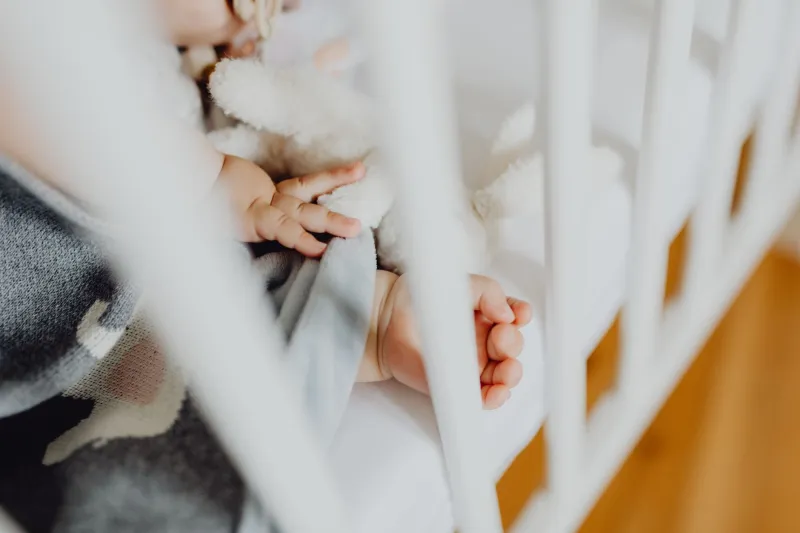
Always use a new mattress for each baby. This is one of the few near-absolute rules in baby sleep safety. A used mattress can be softened, stained, mouldy or full of dust mites, and you can't clean it back to new. It also needs to be firm, flat and fit the cot or Moses basket with no gaps around the edges.
If you're reusing a family Moses basket, check whether the mattress can be replaced. Many can, and a new one is usually inexpensive. Don't borrow a mattress, even from a sibling. It's not worth the worry.
Bottles, teats and dummies
Teats and dummies are wear items. Silicone degrades, scratches can harbour bacteria, and micro-cracks are hard to see. Buy teats new, and replace dummies if they're sticky, torn or discoloured.
Bottles can be reused if they're glass or undamaged BPA-free plastic, and sterilised before use. Since 2011, BPA has been banned in baby bottles in the UK, but older bottles may still be floating around in cupboards. Check for cloudiness, cracks, worn threads and loose lids. If in doubt, retire it.
Slings and carriers
Check the seams, buckles and fabric. A sling that has been used daily for two years may be perfectly fine, or it may have worn straps. Look up the brand and model for recalls, and make sure it comes with instructions or that you can find them online.
A safe sling keeps baby tight, in view at all times, close enough to kiss, with the chin off the chest and the back supported. Avoid bag-style slings and anything with frayed stitching. If it feels flimsy or the buckles don't click securely, pass.
Cots, high chairs and prams
For cots, look for BS EN 716 and check the bar spacing, stability and fixings. There should be no gaps where a head could get stuck, no horizontal bars, no decorative cutouts and no missing screws. Avoid antique cots and anything painted with old lead paint. If a piece of furniture wobbles, has been repaired with tape or is missing parts, it's a no.
High chairs should meet BS EN 14988, with a five-point harness, a crotch post and a stable base. Prams and pushchairs should meet BS EN 1888, with working brakes, a secure harness and no sharp edges or trap points. Check the model for recalls before you use it.
The two-minute recall check
Search the Government's product safety database and the manufacturer's website using the model number, not just the name. Check for repair programmes and safety notices. If a product has been recalled, stop using it and follow the manufacturer's advice. It's a small habit that catches big problems.
Questions to ask before you say yes
- Has it been in a car crash, even a minor one?
- Where has it been stored: loft, garage, damp shed or smoke-free home?
- Do you have the instructions and all the parts?
- Has it been modified, painted or repaired?
- Are there any recalls or safety notices for this model?
- Can I check the label and model number?
- Has it been used around pets or in a smoking household?
Cleaning without weakening it
Follow the care label. Don't soak car seat harnesses in detergent, as it can damage the webbing. Wipe the shell with mild soap and wash fabrics on the recommended cycle. Sterilise bottles before use. For mattresses, there is no cleaning that makes a used one new.
The bottom line
Hand-me-downs are a lifeline for cash-conscious families, and they're better for the planet too. Say yes to most of it. Be picky about car seats and mattresses, and buy teats new. Ask the awkward questions, do the recall check, and trust your gut. A safe nursery isn't about spending the most; it's about knowing what you've got.